
Learning to drive has always meant learning one thing: how to operate a gas powered vehicle. The sounds, vibrations, gear changes, and fueling routines have become so familiar that most people assume driving itself will always feel this way.
The electric vehicle has changed the experience of driving.
Today, new drivers are increasingly finding themselves behind the wheel of an EV for their very first driving lesson. While the rules of the road remain the same, the experience of learning to drive is surprisingly different. In many ways, EVs remove some of the traditional challenges that have long been part of driver education, creating a smoother and more intuitive learning experience.
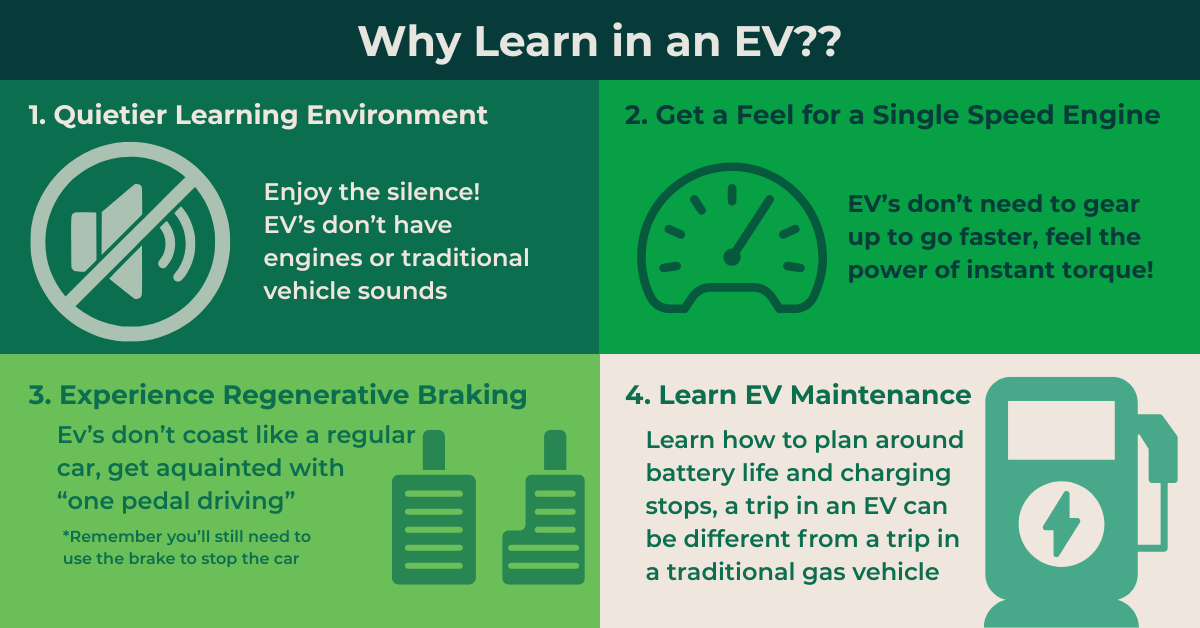
The First Thing You’ll Notice: Silence
Anyone who drives a gas powered vehicle knows the constant soundtrack of the engine. Acceleration brings rising engine noise, idling creates vibration, and most of us rely on sound to understand what the vehicle is doing.
In an EV, you’ll notice the silence.
When you press the accelerator, the vehicle moves quietly. There is no engine revving, no vibration at stoplights, and no dramatic change in sound as speed increases.
For new drivers, it creates a calmer experience where they can focus on steering, positioning, traffic awareness, and road signs rather than interpreting engine behavior.
Instant Acceleration Changes the Learning Curve
While EVs simplify many aspects of driving, they introduce one important adjustment: instant torque.
In a gasoline vehicle, acceleration builds gradually as the engine revs and gears change. EVs deliver maximum torque almost immediately.
For new drivers, this can feel surprisingly responsive. A small movement of the accelerator pedal may produce stronger acceleration than you would expect if you were in a gas powered vehicle.
Learning smooth pedal control becomes especially important in an EV. The good news is that most learners adapt quickly, usually, after the first session. Many students find the responsiveness easier to manage because the vehicle reacts predictably and without the delays common in combustion engines.
Regenerative Braking: A New Way to Slow Down
Perhaps the most significant difference between learning in an EV and learning in a gas vehicle is regenerative braking.
When drivers lift off the accelerator in many EVs, the vehicle automatically begins slowing down while simultaneously recovering energy and sending it back to the battery.
This creates what is often called “one-pedal driving.”
For someone trained exclusively in a traditional vehicle, this can feel unusual at first. In a gas car, lifting off the accelerator typically results in a gradual coast. In an EV, releasing the pedal produces noticeable deceleration.
New drivers often adapt surprisingly fast because they learn the behavior from the beginning. Many eventually discover that they can control speed more precisely and use the brake pedal less frequently.
Refueling vs. Recharging
Learning to drive a gas vehicle typically includes a lesson on visiting a gas station. The process is quick, familiar, and standardized.
EV drivers must learn an entirely different mindset. Charging often happens at home, at work, or while shopping rather than during a dedicated fueling stop.
For new drivers, this introduces concepts such as charging speeds, battery range, charging networks, and route planning.
Although charging requires more forethought on long trips, many EV owners eventually discover they spend less time making special fueling stops because their vehicle is frequently charged while parked.
Which Is Easier to Learn On?
For most beginners, an EV is arguably easier to learn on.
The vehicle is quieter. It has fewer mechanical distractions. There are no gears to manage, no stalling concerns, and less complexity in day-to-day operation.
That simplicity allows learners to focus on what truly matters: awareness, judgment, hazard perception, and safe driving habits.
However, learning on an Internal combustion engine vehicle may provide a broader understanding of traditional automotive systems and can prepare drivers to operate a wider variety of vehicles.
The best choice ultimately depends on what vehicles a learner expects to drive in the future.
The Future of Driver Education
As electric vehicles become increasingly common, here at DriveWise, we will continue to adapt our teaching methods. Future generations of drivers may view engine noise, gear changes, and fuel stops the same way modern drivers view hand cranks and manual choke controls, as skills that once mattered but are no longer central to everyday driving.
Learning to drive has always been about freedom, responsibility, and confidence. Whether that journey begins in an EV or a vehicle with an internal combustion engine, the destination remains the same.
The difference is that for many new drivers, the path is becoming quieter, simpler, and more electric.
At DriveWise, we strongly encourage booking a lesson in both vehicle types. As EVs become more common on the road, it’s beneficial for students to have experience driving, and planning for trips in an EV and a gas vehicle. Having knowledge of how both vehicles handle and the process for refilling, ensuring students are prepared for any driving experience they may encounter in the future.