As summer winds down and students head back to the classroom, B.C. roads get noticeably busier. Morning drop-offs, afternoon pickups, school buses, cyclists, pedestrians and young drivers all share the roads, often at the same time.
September is an especially important month for drivers to slow down and pay attention. According to ICBC, crashes involving minors are 37% higher in September than the monthly average, and children are more than twice as likely to be involved in a crash during morning and afternoon school commute periods than at other times of day.
Whether you’re a parent driving your kids to school, a commuter passing through a school zone, or a new driver getting used to increased traffic, a few extra precautions can make a big difference.
Know Your School Zone Speed Limit
One of the most important things to remember when driving near a school is that the speed limit may change depending on the time of day.
In B.C., a 30 km/h speed limit generally applies in school zones on school days from 8 a.m. to 5 p.m., unless otherwise posted. Some school zones may have extended hours, so always check the signs as you approach.
Playground zones are different. A 30 km/h limit applies in a marked playground zone from dawn until dusk every day, unless otherwise posted.
Don’t wait until you’re beside the sign to slow down
If you see a school zone sign ahead, start scanning your surroundings and adjust your speed smoothly. School areas can have:
Driving at a lower speed gives you more time to recognize a hazard and stop.
Watch Carefully for Children
Children don’t always behave predictably around traffic.
A child may suddenly run after a ball, cross the street unexpectedly, step out from behind a parked vehicle or change direction while riding a bicycle or scooter.
That’s why driving defensively around schools means looking beyond the vehicle immediately in front of you.
Scan the sidewalks, driveways, parked cars, crosswalks and intersections — not just the road ahead.
If another vehicle has stopped near a crosswalk or school entrance, don’t automatically pass it. The driver may be stopped because a pedestrian is crossing.
ICBC specifically advises drivers to be prepared to stop when another vehicle stops in front of them or in an adjacent lane, as it may be yielding to a pedestrian.
School Buses: Know When to Stop
School buses deserve extra attention because children may be crossing the road around them.
In B.C., when a school bus is stopped and displaying a signal indicating that it is receiving or discharging children, drivers approaching the bus from both directions must stop and remain stopped until the bus resumes motion or the bus driver indicates it is safe to proceed.
See flashing school bus lights? Stop.
Don’t try to squeeze past a school bus because you think you have enough room.
Children getting off a bus may need to cross the road, and they can be difficult to see from behind or around the bus.
Give the bus, and the children around it, plenty of space.
Slow Down Around School Drop-Off and Pick-Up Areas
School drop-off zones can become chaotic quickly.
Cars may be:
As a driver, expect the unexpected.
If you’re dropping off a child, use designated areas whenever possible. Avoid stopping in a crosswalk, no-stopping area or location that blocks visibility for other drivers and pedestrians. ICBC recommends having children exit the vehicle on the side closest to the sidewalk.
And remember: being in a hurry doesn’t make the drop-off zone safer.
If traffic is backed up, be patient. A few extra minutes isn’t worth putting a child, or another road user, at risk.
Keep Your Phone Out of Reach
School zones are exactly where you need your full attention.
Looking down at your phone for even a few seconds can mean missing a pedestrian, cyclist, stop sign or child entering the roadway.
ICBC identifies distracted and inattentive driving as a leading cause of crashes involving pedestrians and cyclists.
Before you start driving:
Phone away. Eyes up. Mind on the road.
If you need to change your music, navigation or message someone, pull over somewhere safe first.
Give Yourself More Following Distance
Traffic tends to slow down around schools, especially during morning drop-off and afternoon pickup.
Don’t follow the vehicle ahead too closely. Leave enough space to stop if they suddenly brake for a pedestrian, cyclist or school bus.
A larger following distance also gives you more time to react when traffic becomes unpredictable.
The goal isn’t just to see a hazard, it’s to have enough time and space to respond to it.
Be Extra Careful When Backing Up
School parking lots and residential streets can be particularly challenging because children can be hidden behind vehicles.
Before getting into your vehicle, check around it for children, bicycles, scooters or other obstacles. When reversing, check all around your vehicle and don’t rely solely on your mirrors or backup camera.
Backup cameras are helpful, but they don’t replace physically checking your surroundings.
This is especially important during school pickup, when children may be moving between parked vehicles.
Watch for More Than Just Pedestrians
Back-to-school traffic isn’t limited to people walking.
Keep an eye out for:
Don’t Let Other Drivers Influence Your Speed
One of the most common challenges in school zones is the pressure to keep up with traffic.
You might have someone behind you who seems impatient. Another driver might pass you after you’ve slowed down for a school zone.
Don’t let that influence your decision.
In a 2025 ICBC survey, 31% of B.C. drivers admitted to speeding in school zones at least sometimes, while 91% said they had observed another driver speeding in a school zone.
If the posted limit is 30 km/h, your responsibility is to follow the posted limit — regardless of what the vehicle behind you is doing.
Expect September to Be Especially Busy
The first few weeks of school can be particularly unpredictable.
Families are getting back into routines, students are learning new routes, and drivers are adjusting to increased traffic around schools.
ICBC reports that September has the highest number of children injured while walking or biking compared with other months, with approximately 50 children injured in B.C. in September.
That makes the beginning of the school year a good reminder to slow down and reset your driving habits.
Before you leave home, ask yourself:
If the answer to all six is yes, you’re already taking important steps toward safer driving.
Back-to-School Safety Starts With Every Driver
Keeping school zones safe isn’t just the responsibility of parents, teachers, crossing guards or school bus drivers.
It’s everyone’s responsibility.
Whether you’re driving through a school zone for two minutes or spending your entire morning in school traffic, slow down, stay alert and expect the unexpected.
For new drivers especially, September is a great opportunity to practice defensive driving skills: scanning ahead, maintaining a safe following distance, managing distractions and anticipating what other road users might do next.
Because when children are heading to and from school, getting there safely is more important than getting there quickly.
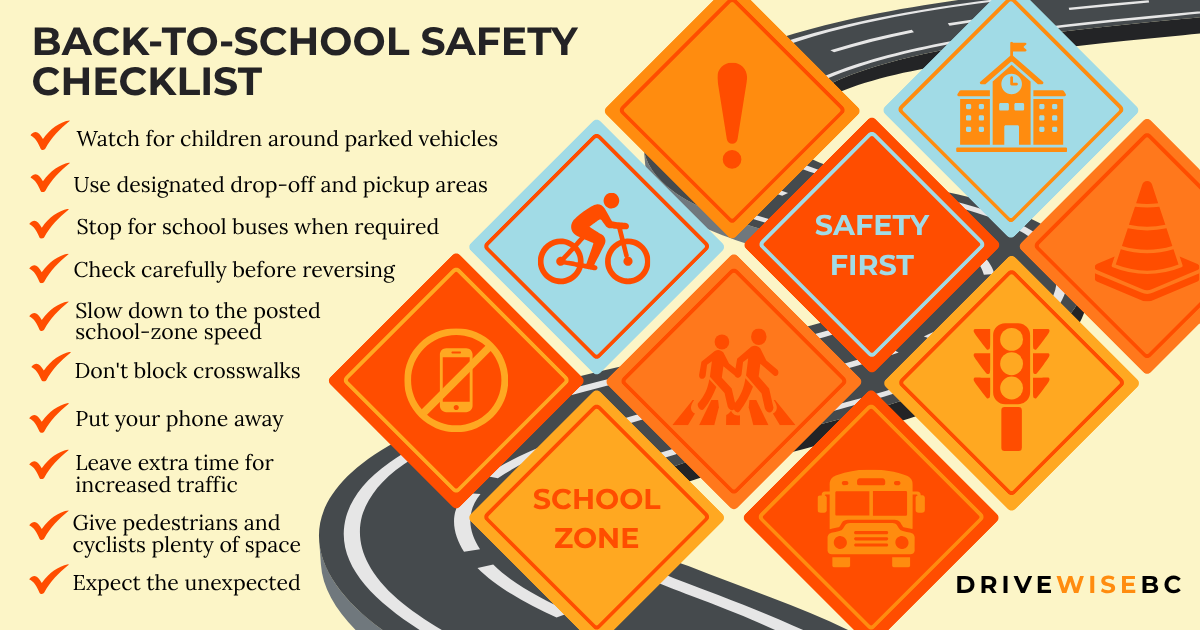
Quick Reminder: Back-to-School Driving Checklist
DriveWise BC Tip
One of the best defensive-driving habits you can develop is looking for the hazard before it becomes a hazard.
When you’re approaching a school zone, don’t just ask, “What is happening right now?”
Ask yourself, “What could happen next?”
That small change in mindset can give you the extra time you need to react safely.
Slow down. Stay alert. Share the road. Let’s make this school year a safe one for everyone.